Which Makes an Empty Ascii Art Picture by Filling a 2d Array With Space Characters
Section 7.5
Ii-dimensional Arrays
Two-dimensional arrays were introduced in Subsection 3.8.5, but nosotros haven't washed much with them since so. A 2D array has a type such every bit int[][] or Cord[][], with ii pairs of square brackets. The elements of a 2D assortment are bundled in rows and columns, and the new operator for 2D arrays specifies both the number of rows and the number of columns. For instance,
int[][] A; A = new int[3][iv];
This creates a 2D array of int that has 12 elements arranged in three rows and 4 columns. Although I haven't mentioned information technology, there are initializers for 2nd arrays. For case, this argument creates the three-by-4 array that is shown in the picture below:
int[][] A = { { 1, 0, 12, -1 }, { seven, -three, 2, 5 }, { -v, -2, two, -9 } }; An array initializer for a 2d array contains the rows of A, separated by commas and enclosed between braces. Each row, in turn, is a list of values separated by commas and enclosed between braces. At that place are also second array literals with a like syntax that tin be used anywhere, not but in declarations. For instance,
A = new int[][] { { one, 0, 12, -1 }, { 7, -three, two, 5 }, { -5, -two, ii, -nine } }; All of this extends naturally to iii-dimensional, four-dimensional, and even higher-dimensional arrays, but they are not used very often in practice.
7.v.1 The Truth About second Arrays
Only before we get any further, there is a niggling surprise. Coffee does not really accept 2-dimensional arrays. In a truthful 2D array, all the elements of the assortment occupy a continuous cake of retention, simply that's not true in Coffee. The syntax for array types is a clue: For any type BaseType, we should be able to course the type BaseType[], meaning "array of BaseType." If we apply int[] as the base of operations type, the type that nosotros go is "int[][] meaning "assortment of int[]" or "array of array of int." And in fact, that's what happens. The elements in a 2D array of type int[][] are variables of blazon int[]. And retrieve that a variable of blazon int[] can only concord a pointer to an array of int. So, a 2D array is really an array of pointers, where each arrow can refer to a i-dimensional array. Those one-dimensional arrays are the rows of the second array. A picture will help to explain this. Consider the 3-by-4 array A divers in a higher place.
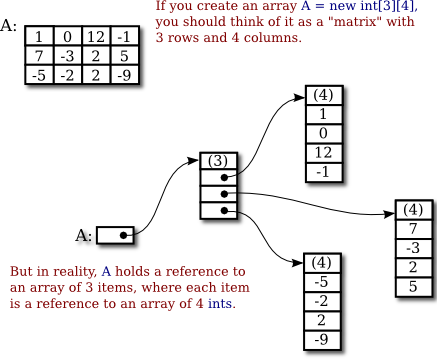
For the about part, you can ignore the reality and keep the motion-picture show of a filigree in mind. Sometimes, though, you volition need to call up that each row in the grid is really an array in itself. These arrays tin be referred to equally A[0], A[1], and A[ii]. Each row is in fact a value of type int[]. It could, for instance, be passed to a subroutine that asks for a parameter of type int[].
Some of the consequences of this structure are a fiddling subtle. For case, thinking of a second assortment, A, equally an array of arrays, we see that A.length makes sense and is equal to the number of rows of A. If A has the usual shape for a 2D assortment, then the number of columns in A would exist the same as the number of elements in the kickoff row, that is, A[0].length. Simply at that place is no dominion that says that all of the rows of A must accept the same length (although an array created with new BaseType[rows][columns] volition always have that form). Each row in a second array is a dissever ane-dimensional array, and each of those arrays can have a different length. In fact, it'southward even possible for a row to be null. For example, the statement
A = new int[3][];
with no number in the second fix of brackets, creates an array of 3 elements where all the elements are null. At that place are places for three rows, but no actual rows have been created. Y'all tin then create the rows A[0], A[1], and A[2] individually.
As an example, consider a symmetric matrix. A symmetric matrix, M, is a two-dimensional array in which the number of rows is equal to the number of columns and satisfying Thousand[i][j] equals M[j][i] for all i and j. Because of this equality, we simply really demand to store Grand[i][j] for i >= j. We tin store the information in a "triangular matrix":
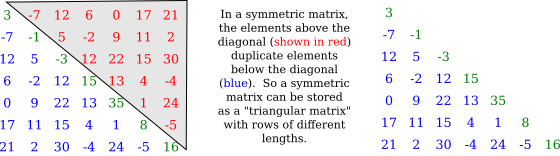
Information technology'due south easy enough to make a triangular assortment, if nosotros create each row separately. To create a 7-by-7 triangular array of double, we can utilise the lawmaking segment
double[][] matrix = new double[seven][]; // rows have non yet been created! for (int i = 0; i < 7; i++) { matrix[i] = new double[i+1]; // Create row i with i + one elements. } Nosotros just have to remember that if we desire to know the value of the matrix at (i,j), and if i < j, then we actually have to get the value of matrix[j][i] in the triangular matrix. And similarly for setting values. It's easy to write a class to represent symmetric matrices:
/** * Represents symmetric n-by-n matrices of real numbers. */ public class SymmetricMatrix { private double[][] matrix; // A triangular matrix to hold the information. /** * Creates an n-by-n symmetric matrix in which all entries are 0. */ public SymmetricMatrix(int n) { matrix = new double[due north][]; for (int i = 0; i < n; i++) matrix[i] = new double[i+i]; } /** * Returns the matrix entry at position (row,col). (If row < col, * the value is actually stored at position (col,row).) */ public double get( int row, int col ) { if (row >= col) return matrix[row][col]; else return matrix[col][row]; } /** * Sets the value of the matrix entry at (row,col). (If row < col, * the value is actually stored at position (col,row).) */ public void ready( int row, int col, double value ) { if (row >= col) matrix[row][col] = value; else matrix[col][row] = value; } /** * Returns the number of rows and columns in the matrix. */ public int size() { render matrix.length; // The size is the number of rows. } } // finish course SymmetricMatrix This course is in the file SymmetricMatrix.java, and a small programme to test it can be constitute in TestSymmetricMatrix.java.
Past the way, the standard role Arrays.copyOf() can't make a total re-create of a 2D array in a single pace. To exercise that, you need to copy each row separately. To make a re-create of a two-dimensional array of int, for example:
int[][] B = new int[A.length][]; // B has as many rows as A. for (int i = 0; i < A.length; i++) { B[i] = Arrays.copyOf(A[i], A[i].length)); // Copy row i. } 7.5.2 Conway'south Game Of Life
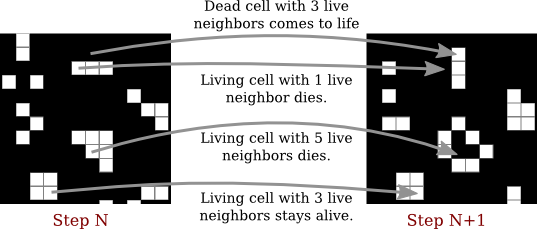
Equally an example of more than typical 2d array processing, let'south wait at a very well-known instance: John Conway'due south Game of Life, invented by mathematician John Horton Conway in 1970. This Game of Life is not really a game (although sometimes it's referred to as a "zero-person game" that plays itself). It'south a "two-dimensional cellular automaton." This simply ways that it'due south a grid of cells whose content changes over time according to definite, deterministic rules. In Life, a jail cell tin can but have two possible contents: Information technology can be "alive" or "expressionless." We volition use a 2D assortment to represent the grid, with each chemical element of the assortment representing the content of one cell in the grid. In the game, an initial grid is set up in which each jail cell is marked as either alive or expressionless. Later that, the game "plays itself." The grid evolves through a series of fourth dimension steps. The contents of the grid at each fourth dimension step are completely determined by the contents at the previous time stride, co-ordinate to unproblematic rules: Each cell in the grid looks at its eight neighbors (horizontal, vertical, and diagonal) and counts how many of its neighbors are alive. And so the state of the cell in the next step is determined by the rules:
- If the prison cell is live in the current time footstep: If the cell has 2 or 3 living neighbors, then the prison cell remains live in the next time step; otherwise, it dies. (A living jail cell dies of loneliness if it has 0 or 1 living neighbor, and of overcrowding if it has more than iii living neighbors.)
- If the cell is dead in the current fourth dimension stride: If the cell has three living neighbors, then the cell becomes alive in the side by side fourth dimension step; otherwise, it remains dead. (Three living cells give nascency to a new living cell.)
Here's a moving picture of part of a Life board, showing the aforementioned board earlier and after the rules have been applied. The rules are applied to every cell in the grid. The picture shows how they apply to four of the cells:
The Game of Life is interesting because it gives rise to many interesting and surprising patterns. (Expect it upwardly on Wikipedia.) Hither, nosotros are merely interested in writing a program to simulate the game. The consummate programme can be constitute in the file Life.java. In the plan, the life grid is shown every bit a grid of squares in which expressionless squares are black and living squares are white. (The program uses MosaicCanvas.java from Section four.7 to represent the grid, so yous will as well need that file to compile and run the plan.) In the plan, you can fill up the life board randomly with dead and alive cells, or you tin use the mouse to ready the game board. At that place is a "Footstep" button that volition compute 1 time-step of the game, and a "Beginning" button that will run time steps as an blitheness.
We'll expect at some of the array processing involved in implementing the Game of Life for this program. Since a cell can only be alive or dead, it is natural to utilize a two-dimensional array of boolean[][] to represent us of all the cells. The array is named alive, and alive[r][c] is true when the cell in row r, column c is alive. The number of rows and the number of columns are equal and are given past a constant, GRID_SIZE. So, for example, to fill the Life grid with random values, the program uses elementary nested for loops:
for (int r = 0; r < GRID_SIZE; r++) { for (int c = 0; c < GRID_SIZE; c++) { // Use a 25% probability that the cell is alive. live[r][c] = (Math.random() < 0.25); } } Notation that the expression (Math.random() < 0.25) is a truthful/false value that tin be assigned to a boolean array element. The array is also used to prepare the color of the cells on the screen. Since the grid of cells is displayed on screen equally a MosaicCanvas, setting the colors is done using the MosaicCanvas API. Note that the actual drawing is done in the MosaicCanvas class (which has its own 2D array of type Colour[][] to keep rails of the colors of each cell). The Life plan just has to set the colors in the mosaic, using the MosaicCanvas API. This is done in the program in a method named showBoard() that is called each time the board changes. Again, simple nested for loops are used to set the color of each foursquare in the grid:
for (int r = 0; r < GRID_SIZE; r++) { for (int c = 0; c < GRID_SIZE; c++) { if (alive[r][c]) display.setColor(r,c,Color.WHITE); else display.setColor(r,c,null); // Shows the background color, black. } } Of course, the about interesting part of the plan is computing the new land of the board by applying the rules to the current country. The rules apply to each individual cell, so again we tin can utilize nested for loops to work through all the cells on the board, only this time the processing is more complicated. Notation first that we can't make changes to the values in the array every bit we work through it, since we will need to know the onetime state of a cell when processing its neighboring cells. In fact, the program uses a second assortment to hold the new board as it is being created. When the new board is finished, it can be substituted for the old board. The algorithm goes like this in pseudocode:
let newboard be a new boolean[][] assortment for each row r: for each column c: Permit Due north be the number of neighbors of cell (r,c) in the live array if ((Northward is 3) or (N is 2 and alive[r][c])) newboard[r][c] = true; else newboard[r][c] = false; alive = newboard
Note that at the end of the procedure, alive is pointing to a new array. This doesn't matter equally long as the contents of the array represent the new state of the game. The old assortment volition be garbage collected. The examination for whether newboard[r][c] should be true or false might not be obvious, but it implements the rules correctly. We still need to work on counting the neighbors. Consider the cell in row r and cavalcade c. If information technology's not at an edge of the lath, and so it's clear where its neighbors are:
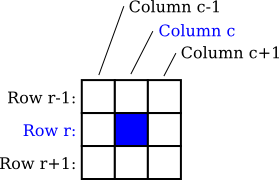
The row to a higher place row number r is row number r-i, and the row below is r+one. Similarly for the columns. We just have to await at the values of alive[r-1][c-1], alive[r-1][c], alive[r-1][c+ane], alive[r][c-i], alive[r][c+i], alive[r+1][c-1], alive[r+i][c], and alive[r+1][c+1], and count the number that are truthful. (You should make sure that you empathise how the array indexing works here.)
But at that place is a problem when the cell is forth one of the edges of the grid. In that case, some of the assortment elements in the list don't exist, and an attempt to utilize them will crusade an exception. To avoid the exception, we take to give special consideration to cells forth the edges. 1 idea is that before referencing whatsoever array element, cheque that the array chemical element actually exists. In that example, the code for neighbor counting becomes
if (r-ane >= 0 && c-1 >= 0 && live[r-1][c-ane]) North++; // A jail cell at position (r-i,c-1) exists and is live. if (r-1 >= 0 && alive[r-1][c]) N++; // A cell at position (r-1,c) exists and is alive. if (r-i >= 0 && c+1 <= GRID_SIZE && alive[r-1][c+ane]) Northward++; // A cell at position (r-1,c+1) exists and is alive. // and and then on...
All the possible exceptions are avoided. Only in my plan, I actually do something that is common in second computer games—I pretend that the left border of the lath is attached to the right edge and the top border to the lesser border. For example, for a cell in row 0, we say that the row "above" is really the bottom row, row number GRID_SIZE-ane. I use variables to represent the positions in a higher place, below, left, and right of a given cell. The code turns out to be simpler than the lawmaking shown to a higher place. Hither is the complete method for calculating the new board:
private void doFrame() { // Compute the new state of the Life lath. boolean[][] newboard = new boolean[GRID_SIZE][GRID_SIZE]; for ( int r = 0; r < GRID_SIZE; r++ ) { int above, below; // rows considered above and below row number r int left, correct; // columns considered left and right of column c above = r > 0 ? r-one : GRID_SIZE-ane; // (for "?:" see Subsection ii.5.5) below = r < GRID_SIZE-i ? r+1 : 0; for ( int c = 0; c < GRID_SIZE; c++ ) { left = c > 0 ? c-1 : GRID_SIZE-ane; correct = c < GRID_SIZE-1 ? c+i : 0; int n = 0; // number of alive cells in the eight neighboring cells if (alive[in a higher place][left]) northward++; if (alive[above][c]) n++; if (alive[to a higher place][right]) n++; if (alive[r][left]) northward++; if (alive[r][right]) n++; if (live[below][left]) n++; if (alive[below][c]) n++; if (alive[below][right]) n++; if (n == three || (alive[r][c] && northward == two)) newboard[r][c] = true; else newboard[r][c] = fake; } } alive = newboard; } Again, I urge you lot to cheque out the source code, Life.java, and try the program. Don't forget that you will also demand MosaicCanvas.java.
seven.5.3 Checkers
As a final instance for this chapter, we'll wait at a more substantial instance of using a second assortment. This is the longest program that we have encountered so far, with 745 lines of code. The program lets two users play checkers against each other. The checkers game is played on an eight-past-eight board, which is based on an example from Subsection 6.v.i. The players are called "ruddy" and "blackness," after the colour of their checkers. I'one thousand not going to explain the rules of checkers here; possibly you tin learn them past trying out the programme.
In the program, a player moves by clicking on the piece that they want to move, and so clicking on the empty square to which it is to be moved. As an aid to the players, any foursquare that the electric current player can legally click at a given time is highlighted with a brightly colored edge. The square containing a slice that has been selected to exist moved, if any, is surrounded past a yellow border. Other pieces that can legally be moved are surrounded by a cyan-colored edge. If a piece has already been selected to be moved, each empty square that it can legally movement to is highlighted with a light-green edge. The game enforces the dominion that if the current player can jump 1 of the opponent's pieces, then the player must jump. When a thespian's piece becomes a king, past reaching the opposite end of the board, a big white "K" is drawn on the slice. Here is a picture of the programme early in a game. It is black's turn to motion. Black has selected the slice in the xanthous-outlined square to be moved. Black tin can click one of the squares outlined in green to complete the move, or can click i of the squares outlined in cyan to select a different piece to be moved.
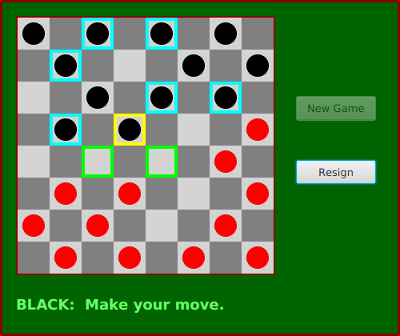
I will only encompass a part of the programming for this case. I encourage you to read the complete source code, Checkers.java. It's long and complex, but with some study, y'all should sympathize all the techniques that it uses. The program is a good instance of land-based, effect-driven, object-oriented programming.
The data about the pieces on the board are stored in a two-dimensional array. Considering of the complexity of the program, I wanted to dissever it into several classes. In addition to the main class, there are several nested classes. 1 of these classes is CheckersData, which handles the information for the board. It is non straight responsible for any part of the graphics or event-handling, simply it provides methods that can be called past other classes that handle graphics and events. It is mainly this grade that I want to talk well-nigh.
The CheckersData class has an example variable named board of type int[][]. The value of board is set to "new int[viii][viii]", an 8-by-viii grid of integers. The values stored in the grid are defined as constants representing the possible contents of a square on a checkerboard:
static final int EMPTY = 0, // Value representing an empty square. Blood-red = 1, // A regular crimson piece. RED_KING = 2, // A blood-red king. BLACK = 3, // A regular black slice. BLACK_KING = 4; // A black king.
The constants Blood-red and BLACK are also used in my program (or, maybe, misused) to represent the two players in the game. When a game is started, the values in the array are set to stand for the initial state of the board. The grid of values looks like
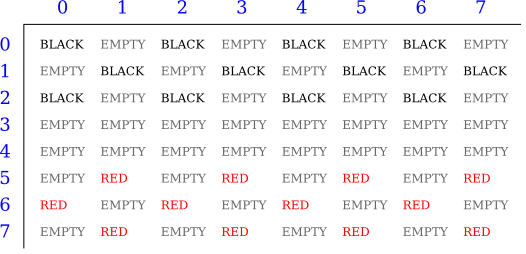
A regular black piece can merely move "down" the grid. That is, the row number of the square it moves to must be greater than the row number of the square it comes from. A regular cherry-red slice can only move up the grid. Kings of either color can movement in both directions.
One part of the CheckersData course is to take care of changes to the data structures that need to be made when 1 of the users moves a checker. An instance method named makeMove() is provided to do this. When a player moves a piece from i square to another, the values of two elements in the array are changed. But that'due south non all. If the move is a spring, then the slice that was jumped is removed from the board. (The method checks whether the move is a bound by checking if the square to which the piece is moving is two rows away from the foursquare where it starts.) Furthermore, a RED slice that moves to row 0 or a Blackness piece that moves to row seven becomes a king. Putting all that into a subroutine is skillful programming: the rest of the program doesn't have to worry about any of these details. It just calls this makeMove() method:
/** * Make the move from (fromRow,fromCol) to (toRow,toCol). Information technology is * Assumed that this move is legal! If the motility is a leap, the * jumped slice is removed from the board. If a piece moves * to the last row on the opponent'south side of the board, the * slice becomes a king. */ void makeMove(int fromRow, int fromCol, int toRow, int toCol) { board[toRow][toCol] = lath[fromRow][fromCol]; // Motility the piece. board[fromRow][fromCol] = EMPTY; // The square information technology moved from is now empty. if (fromRow - toRow == 2 || fromRow - toRow == -two) { // The movement is a jump. Remove the jumped slice from the board. int jumpRow = (fromRow + toRow) / 2; // Row of the jumped piece. int jumpCol = (fromCol + toCol) / 2; // Column of the jumped piece. lath[jumpRow][jumpCol] = EMPTY; } if (toRow == 0 && board[toRow][toCol] == Ruby) lath[toRow][toCol] = RED_KING; // Red piece becomes a male monarch. if (toRow == seven && board[toRow][toCol] == BLACK) board[toRow][toCol] = BLACK_KING; // Blackness piece becomes a rex. } // end makeMove() An even more than important function of the CheckersData class is to detect legal moves on the board. In my programme, a move in a Checkers game is represented by an object belonging to the following grade:
/** * A CheckersMove object represents a motility in the game of * Checkers. It holds the row and column of the piece that is * to be moved and the row and cavalcade of the square to which * information technology is to be moved. (This class makes no guarantee that * the move is legal.) */ private static grade CheckersMove { int fromRow, fromCol; // Position of piece to be moved. int toRow, toCol; // Foursquare information technology is to move to. CheckersMove(int r1, int c1, int r2, int c2) { // Constructor. Set the values of the instance variables. fromRow = r1; fromCol = c1; toRow = r2; toCol = c2; } boolean isJump() { // Test whether this move is a jump. It is assumed that // the move is legal. In a jump, the piece moves two // rows. (In a regular move, it only moves i row.) return (fromRow - toRow == two || fromRow - toRow == -2); } } // end form CheckersMove. The CheckersData grade has an instance method which finds all the legal moves that are currently bachelor for a specified player. This method is a role that returns an array of blazon CheckersMove[]. The array contains all the legal moves, represented as CheckersMove objects. The specification for this method reads
/** * Return an array containing all the legal CheckersMoves * for the specified thespian on the electric current board. If the player * has no legal moves, zero is returned. The value of player * should be one of the constants RED or BLACK; if not, nada * is returned. If the returned value is not-null, it consists * entirely of jump moves or entirely of regular moves, since * if the player tin jump, only jumps are legal moves. */ CheckersMove[] getLegalMoves(int role player)
A brief pseudocode algorithm for the method is
Commencement with an empty listing of moves Find whatever legal jumps and add together them to the list if at that place are no jumps: Find any other legal moves and add them to the list if the list is empty: return null else: return the listing
Now, what is this "listing"? We take to return the legal moves in an assortment. Simply since an array has a fixed size, we can't create the assortment until we know how many moves there are, and we don't know that until near the end of the method, after we've already made the list! A neat solution is to use an ArrayList instead of an array to hold the moves every bit nosotros discover them. In fact, I use an object defined by the parameterized type ArrayList<CheckersMove> so that the list is restricted to holding objects of blazon CheckersMove. Equally nosotros add moves to the list, it volition grow just equally large as necessary. At the end of the method, we can create the array that we really want and copy the data into it:
Let "moves" be an empty ArrayList<CheckersMove> Observe any legal jumps and add together them to moves if moves.size() is 0: // In that location are no legal jumps! Observe any other legal moves and add together them to moves if moves.size() is 0: // At that place are no legal moves at all! return nix else: Permit moveArray exist an assortment of CheckersMoves of length moves.size() Copy the contents of moves into moveArray return moveArray
Now, how do we find the legal jumps or the legal moves? The information we need is in the board assortment, just it takes some work to extract it. We have to expect through all the positions in the array and find the pieces that belong to the electric current role player. For each slice, we have to check each square that it could conceivably move to, and check whether that would be a legal motion. If nosotros are looking for legal jumps, nosotros want to look at squares that are two rows and two columns away from the piece. At that place are 4 squares to consider. Thus, the line in the algorithm that says "Find any legal jumps and add them to moves" expands to:
For each row of the board: For each column of the lath: if i of the histrion'due south pieces is at this location: if it is legal to jump to row + 2, column + two add this move to moves if it is legal to spring to row - two, column + two add this move to moves if it is legal to jump to row + two, column - 2 add together this motion to moves if it is legal to jump to row - 2, column - two add this motion to moves
The line that says "Find any other legal moves and add them to moves" expands to something similar, except that we have to await at the 4 squares that are 1 column and one row abroad from the piece. Testing whether a thespian tin can legally move from ane given square to another given square is itself non-picayune. The square the actor is moving to must really be on the board, and it must exist empty. Furthermore, regular red and blackness pieces can just move in one direction. I wrote the following utility method to check whether a actor can make a given not-bound move:
/** * This is called past the getLegalMoves() method to determine * whether the player can legally move from (r1,c1) to (r2,c2). * It is Assumed that (r1,c1) contains i of the player's * pieces and that (r2,c2) is a neighboring square. */ private boolean canMove(int player, int r1, int c1, int r2, int c2) { if (r2 < 0 || r2 >= 8 || c2 < 0 || c2 >= 8) return false; // (r2,c2) is off the lath. if (lath[r2][c2] != EMPTY) render simulated; // (r2,c2) already contains a piece. if (actor == RED) { if (board[r1][c1] == Ruby-red && r2 > r1) return false; // Regular red piece can simply move down. return true; // The motility is legal. } else { if (board[r1][c1] == BLACK && r2 < r1) return false; // Regular black slice tin only motion up. return true; // The motion is legal. } } // end canMove() This method is called past my getLegalMoves() method to check whether one of the possible moves that information technology has found is actually legal. I have a similar method that is chosen to check whether a leap is legal. In this instance, I pass to the method the square containing the actor's piece, the square that the player might move to, and the square betwixt those ii, which the histrion would exist jumping over. The foursquare that is being jumped must contain one of the opponent's pieces. This method has the specification:
/** * This is chosen by other methods to cheque whether * the histrion tin can legally jump from (r1,c1) to (r3,c3). * It is assumed that the player has a piece at (r1,c1), that * (r3,c3) is a position that is 2 rows and 2 columns afar * from (r1,c1) and that (r2,c2) is the square between (r1,c1) * and (r3,c3). */ private boolean canJump(int actor, int r1, int c1, int r2, int c2, int r3, int c3) { . . . Given all this, you should be in a position to understand the complete getLegalMoves() method. Information technology's a overnice fashion to finish off this chapter, since it combines several topics that we've looked at: one-dimensional arrays, ArrayLists, and two-dimensional arrays:
CheckersMove[] getLegalMoves(int thespian) { if (player != Blood-red && player != Black) render nothing; // (This will not happen in a right program.) int playerKing; // The constant for a King belonging to the actor. if (histrion == RED) playerKing = RED_KING; else playerKing = BLACK_KING; ArrayList<CheckersMove> moves = new ArrayList<CheckersMove>(); // Moves will exist stored in this listing. /* Get-go, cheque for whatsoever possible jumps. Look at each square on the lath. If that foursquare contains 1 of the thespian'southward pieces, look at a possible jump in each of the four directions from that square. If in that location is a legal jump in that management, put information technology in the moves ArrayList. */ for (int row = 0; row < eight; row++) { for (int col = 0; col < 8; col++) { if (board[row][col] == player || board[row][col] == playerKing) { if (canJump(player, row, col, row+one, col+1, row+2, col+two)) moves.add together(new CheckersMove(row, col, row+2, col+2)); if (canJump(actor, row, col, row-1, col+one, row-2, col+ii)) moves.add together(new CheckersMove(row, col, row-2, col+two)); if (canJump(role player, row, col, row+1, col-1, row+two, col-2)) moves.add(new CheckersMove(row, col, row+ii, col-two)); if (canJump(actor, row, col, row-ane, col-1, row-ii, col-2)) moves.add together(new CheckersMove(row, col, row-2, col-2)); } } } /* If whatever spring moves were found, then the user must spring, so we don't add any regular moves. However, if no jumps were found, cheque for whatever legal regular moves. Look at each square on the lath. If that square contains 1 of the player'south pieces, look at a possible movement in each of the four directions from that square. If in that location is a legal move in that direction, put it in the moves ArrayList. */ if (moves.size() == 0) { for (int row = 0; row < 8; row++) { for (int col = 0; col < 8; col++) { if (board[row][col] == player || board[row][col] == playerKing) { if (canMove(player,row,col,row+1,col+1)) moves.add together(new CheckersMove(row,col,row+i,col+1)); if (canMove(player,row,col,row-1,col+1)) moves.add(new CheckersMove(row,col,row-one,col+1)); if (canMove(player,row,col,row+1,col-1)) moves.add(new CheckersMove(row,col,row+i,col-1)); if (canMove(actor,row,col,row-i,col-ane)) moves.add(new CheckersMove(row,col,row-one,col-1)); } } } } /* If no legal moves have been found, return zip. Otherwise, create an array just big plenty to agree all the legal moves, copy the legal moves from the ArrayList into the assortment, and return the array. */ if (moves.size() == 0) return zippo; else { CheckersMove[] moveArray = new CheckersMove[moves.size()]; for (int i = 0; i < moves.size(); i++) moveArray[i] = moves.get(i); return moveArray; } } // stop getLegalMoves The checkers plan is complex, and you can be sure that information technology didn't simply fall together. Information technology took a good deal of design work to determine what classes and objects would be used, what methods should be written, and what algorithms the methods should apply. The complete source lawmaking is in the file Checkers.java. Have a look!
End of Chapter 7
Source: https://math.hws.edu/javanotes/c7/s5.html
0 Response to "Which Makes an Empty Ascii Art Picture by Filling a 2d Array With Space Characters"
Post a Comment